


How to Close the AI Context Gap in Governance, Risk, and Compliance

Shambhavi Singh
September 14, 2026
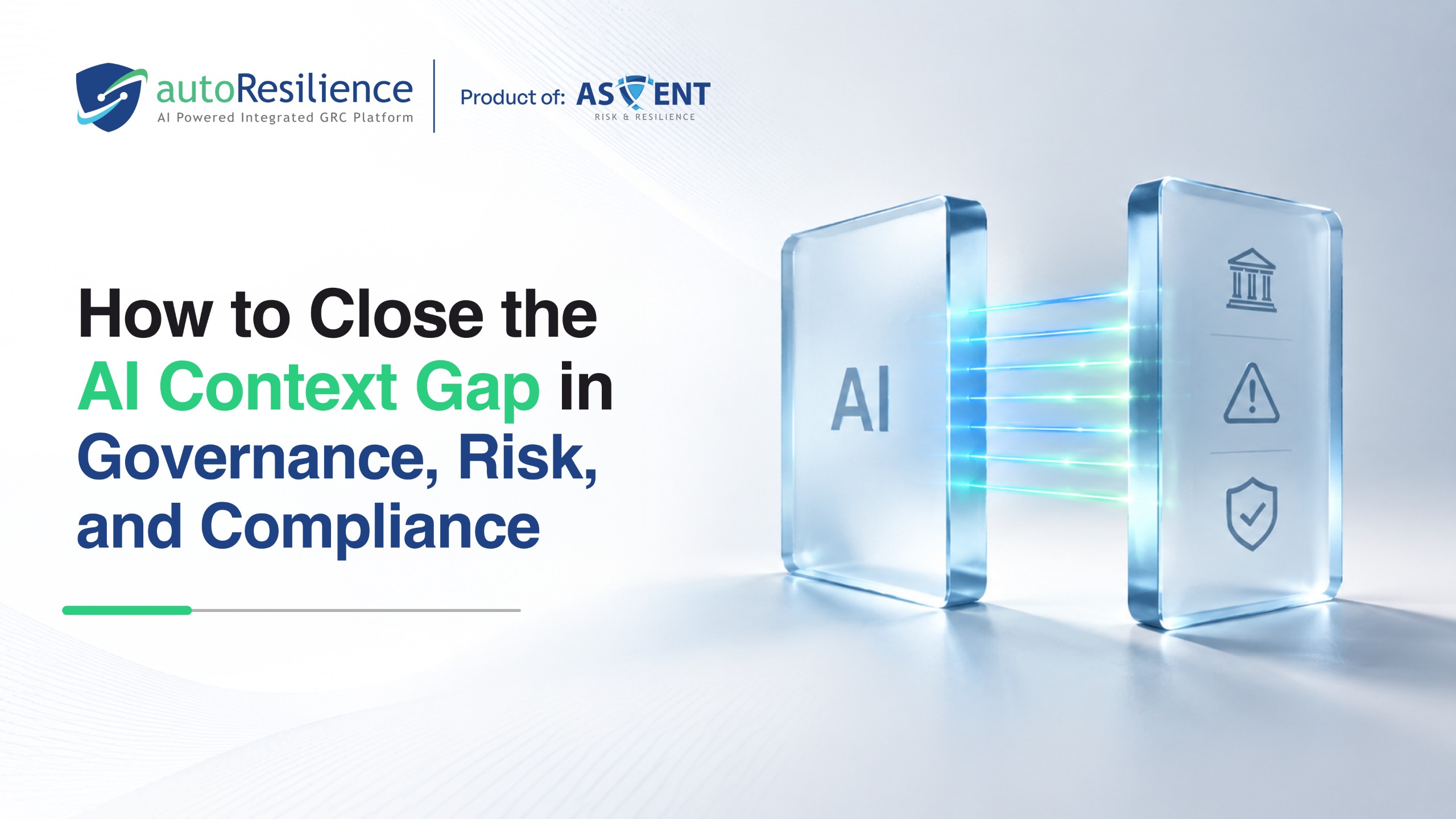
Governance, Risk, and Compliance teams have never had a shortage of data. Risk registers, control libraries, audit findings, policy documents, vendor assessments, incident logs, the volume has only grown as regulations multiply and organizations digitize every corner of their operations. What’s been missing isn’t data. It’s the ability to turn that data into a decision someone can actually act on, quickly enough to matter. This is the AI context gap, and it’s quietly becoming one of the biggest blockers to real GRC transformation.
The Promise Everyone Bought Into
Over the past two years, GRC teams have been told, repeatedly, that AI would fix this. Feed a large language model your policies, your risk data, your audit history, and it would surface insights, draft reports, flag anomalies, and answer questions in seconds instead of days.
For narrow, well-defined tasks, that promise has largely held up. AI can summarize a lengthy regulatory update. It can draft a first pass at a policy document. It can extract clauses from a contract far faster than a human reviewer. These are genuinely useful capabilities, and most GRC teams have already found ways to use them.
But ask that same AI tool a question that requires understanding how a specific control failure connects to which regulatory obligation, which business unit owns the risk, and what similar issues looked like eighteen months ago, and the wheels tend to come off. The model either hedges with a generic answer, or worse, produces something confident-sounding but wrong.
The problem isn’t the AI’s reasoning ability. It’s the AI context gap. The model doesn’t actually know your organization.
What “AI Context Gap” Really Means in GRC
In everyday conversation, “context” sounds like a soft, almost philosophical concept. In GRC, it’s extremely concrete. Context is the accumulated, interconnected knowledge that turns a raw data point into something decision-useful:
- Relationships between entities. A single control doesn’t exist in isolation, it maps to specific regulatory clauses, supports certain business processes, and has an owner who’s accountable when it fails. Without that web of connections, a control status is just a status, not a risk signal.
- Historical pattern. Whether a recurring finding is a new problem or the fifth appearance of an old one changes how urgently it should be treated. A model without access to history treats every finding as if it’s happening for the first time.
- Organizational specifics. Risk appetite, escalation thresholds, and materiality look completely different at a regional bank than at a global manufacturer. Generic AI models trained on public data have no visibility into an organization’s specific risk posture.
- Current state versus stale snapshot. Compliance status changes constantly, new findings, remediated controls, updated regulations. An AI tool answering from a six-month-old data extract will confidently give an answer that’s already wrong.
When any of these layers is missing, the AI can still generate a fluent, well-structured response. That’s precisely what makes the context gap dangerous, the output looks authoritative even when it’s built on an incomplete picture.
Why the Gap Exists
The AI context gap isn’t a failure of technology so much as a reflection of how GRC data has historically been managed.
Data lives in silos. Risk data sits in one system, compliance evidence in another, audit findings in a third, and policy documents in a shared drive that hasn’t been reorganized in years. Even when an AI tool has access to all of these sources, it’s rarely given the relationships that connect them. Feeding a model disconnected documents is very different from feeding it a structured understanding of how those documents relate.
Documentation wasn’t built for machines to reason over. Most GRC documentation was written for human readers who bring their own institutional knowledge to the page. A policy document assumes the reader already knows the org chart, the regulatory landscape, and the history of past incidents. An AI model has none of that background unless it’s explicitly provided.
Real-time data pipelines are rare. Many GRC programs still rely on point-in-time assessments, quarterly reviews, annual audits, periodic control testing. AI tools layered on top of this cadence inherit the same staleness. A model can only be as current as the data it’s connected to, and in most organizations, that data updates far less often than risk actually changes.
Governance of the AI layer itself is immature. Few organizations have clearly defined what data an AI tool should and shouldn’t have access to for GRC use cases, how that access should be scoped by role, or how outputs should be validated before they inform a decision. Without this governance, teams either over-restrict AI tools until they’re nearly useless, or under-restrict them in ways that create new compliance risks of their own.
The Cost of Ignoring It
The consequences of the context gap aren’t abstract. They show up in specific, expensive ways.
A GRC team asks an AI tool to summarize open regulatory findings across business units, and the summary misses a category of findings because the underlying data connection wasn’t complete. Leadership makes a resourcing decision based on that incomplete picture.
A compliance analyst uses AI to draft a response to a regulator, and the tool references a policy version that was superseded three months earlier because it was working from a stale document repository. The response goes out with outdated information.
A risk officer asks an AI assistant whether a specific vendor relationship falls under a new regulatory requirement, and the tool gives a plausible-sounding but incorrect answer because it has no visibility into the specific contractual terms or the vendor’s actual data flows.
None of these failures are dramatic on their own. But in aggregate, they erode trust in AI-assisted GRC work faster than almost anything else, and once trust is lost, teams often revert entirely to manual processes, discarding the genuine value AI could have delivered.
Closing the Gap: What Actually Works
Closing the AI context gap isn’t about finding a smarter model. It’s about rebuilding the foundation the model operates on.
1. Build a Connected Data Layer Before Layering On AI
The single highest-leverage step is establishing a unified, structured data layer that links controls, risks, regulations, policies, and incidents together, rather than leaving them as separate documents in separate systems. This doesn’t require abandoning existing GRC platforms; it means ensuring those platforms are configured to capture relationships, not just records.
2. Treat AI Outputs as a Starting Point, Not a Final Answer
Organizations that get the most value from AI in GRC build in a human validation step for anything that informs a real decision, regulatory response, risk rating, audit conclusion. This isn’t a lack of trust in the technology; it’s an acknowledgment that even well-contextualized AI benefits from a second set of eyes, especially in a discipline where the cost of being wrong is regulatory exposure.
3. Keep the Context Current
A context layer that’s accurate today and stale in three months creates a false sense of reliability. Organizations need mechanisms, whether through integrations, scheduled syncs, or workflow triggers, that keep the underlying GRC data current as controls are tested, findings are remediated, and regulations change.
4. Define Clear Governance for AI Access
Before rolling out AI tools broadly across a GRC function, teams need explicit answers to a few questions: What data can this tool access? Who can use it, and for what specific tasks? How are outputs reviewed before they’re acted on? This governance layer is what prevents the context gap from becoming a new compliance risk in its own right.
5. Start Narrow, Then Expand
Rather than attempting to give an AI tool comprehensive context across the entire GRC function at once, the more successful approach starts with a single, well-scoped use case, say, mapping controls to a specific regulatory framework, and builds out the context layer needed for that use case properly. Success there creates both the data infrastructure and the organizational confidence to expand into adjacent areas.
From Data to Decisions
The organizations getting real value from AI in GRC aren’t the ones with the most sophisticated models. They’re the ones that did the less glamorous work first: connecting their data, defining their relationships, keeping information current, and building the governance to use AI responsibly on top of all of it.
The AI context gap is closeable. But it requires treating context as infrastructure to be built deliberately, not as something an AI model will simply infer on its own. Once that foundation exists, the shift from data to decisions stops being a promise on a vendor’s slide deck and starts being something Governance, Risk & Compliance teams can rely on every day.
Written by

Shambhavi Singh is a Marketing Executive at Ascent Risk & Resilience, where she contributes to brand communication, content strategy, and digital storytelling across the organization’s risk and resilience solutions. With a background spanning content writing, voice-over artistry, anchoring, public speaking, and social impact, she brings both creativity and clarity to every message she crafts.
Shambhavi’s passion for communication started early in her hometown of Varanasi, where her curiosity for culture and heritage shaped her worldview. A natural storyteller and confident speaker, she has built a strong presence as a social media writer and continues to use her voice to inform, inspire, and engage audiences.
Driven by a blend of will and skill, she is committed to building meaningful connections, leading with empathy, and contributing to initiatives that create positive change. A social worker at heart and a marketer by profession, Shambhavi combines creativity, purpose, and leadership in everything she does.