


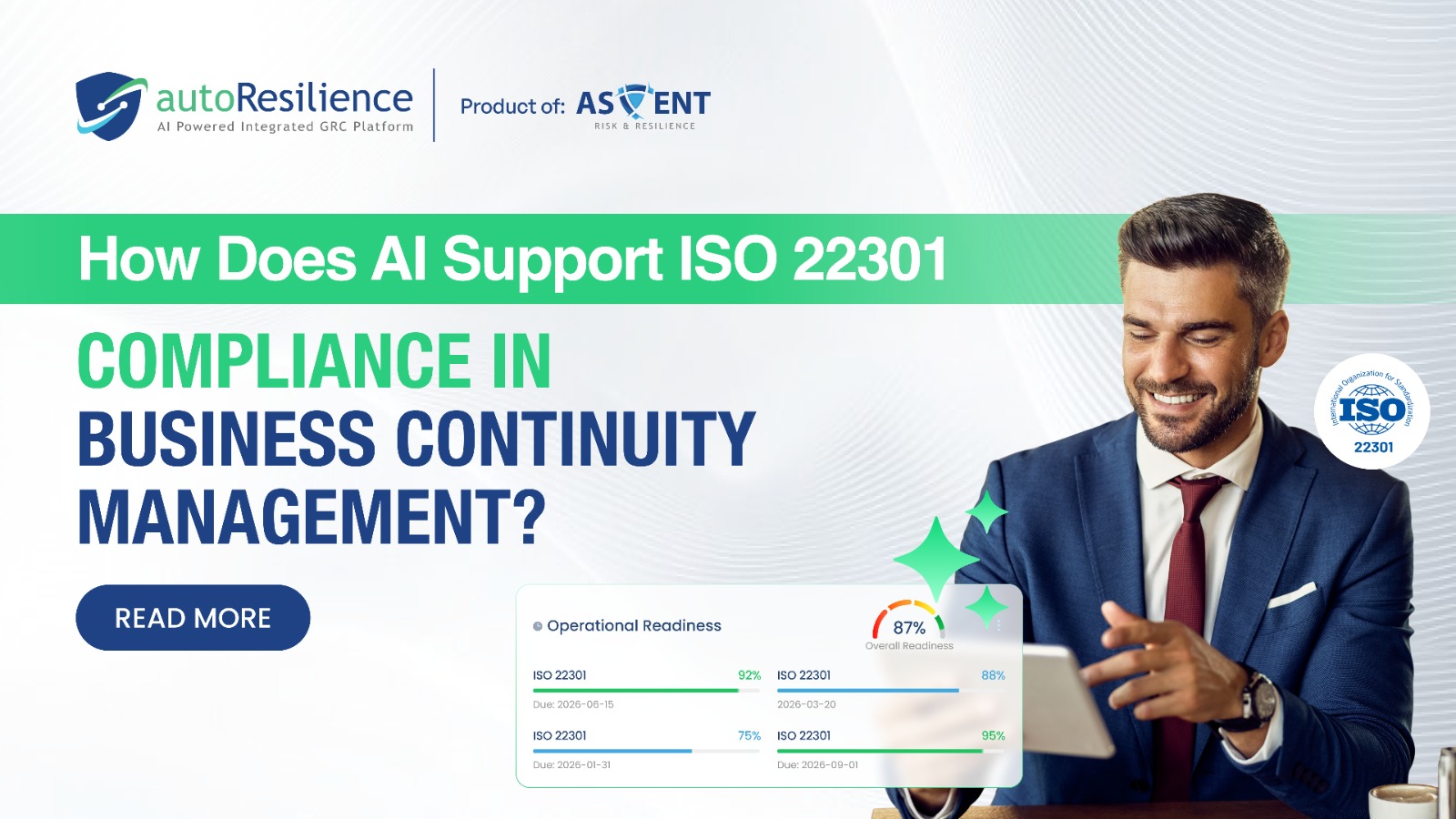
How AI Supports ISO 22301 Compliance in Business Continuity Management?

Shambhavi Singh
February 20, 2026
Artificial Intelligence (AI) is smoothening the way ISO 22301 compliance operates by making Business Continuity Management (BCM) more intelligent, quicker, and more resilient. In this era of uncertainties, businesses have begun to face increased disruptions ranging from operational, cyber, to environmental. Enmeshing AI with ISO 22301 brings proactive risk management, precise business impact analysis, and an ideal incident response.
This blog explores the way AI empowers ISO 22301 compliance in business continuity planning and proves operational resilience at an overall level.
Resilience is dictated by operational demands, and the ability to respond to these demands determines an organization’s business continuity maturity. The need for organizations to break out of all operational silos and develop an ecosystem with resilience embedded at every layer of the organization is key to being prepared to respond to any disruption.
The ability to respond to a change in the market and get the product out before competition is inherent in any successful business. Customers, suppliers, regulators, and competitors all affect an organization’s capability to continue in business. Therefore, organizations need to keep an eye on the stability of its business facilitators including suppliers, raw materials, manufacturers, distributers, sites, and assets to develop a holistic framework of preparedness and readiness.
Resilience is a continuous requirement and no organization, person, network, or system can be absolutely resilient. An organization should be strategically adaptable, operationally aware, and tactically able to respond to any external or internal event. Resilience can never be static, it is constantly changing.
What Is ISO 22301 and Why Is It Important?
ISO 22301 is the international overarching framework for Business Continuity Management Systems (BCMS). It gives out a structured and organized standard that helps enterprises anticipate, prepare, respond, and bounce back from disruptions. It ensures maintaining critical business operations even in the face of adversities.
Key benefits of ISO 22301 include:
- Decrease in downtime during crises
- Enhanced risk management and enterprise resilience
- Regulatory and contractual alignment
- Increased stakeholder trust
Crises have become increasingly complex and this has led to many organizations using AI in business continuity management to meet ISO 22301 requirements more effectively.
Why Is AI Important for ISO 22301 Compliance
Typically traditional BCM has always relied heavily on manual assessments, rigorous documentation, and routine reviews. AI-powered BCM software overcomes these challenges by bringing in and assimilating:
- Synchronized risk assessment
- Real-time analysis and updates
- Effective business impact analysis
- Compliance reporting that is automated
The use of AI can allow enterprises to be completely aligned with ISO 22301 standards. Thus, it helps organizations move away from reactive continuity planning to predictive, proactive, and adaptive planning.
According to a paper published by Business Continuity Institute (BCI) on “Organizational Resilience”, the various disciplines involved in developing a resilience program should focus on the following tenets:
- Anticipation: threats, insurance awareness, strategic risk, operational risk, financial risk, business continuity
- Protection and planning: security, information assurance, health, safety and environment, insurance, governance, compliance, and audit
- Response: crisis management,communications, IT disaster recovery, business continuity
- Recovery: business continuity, insurance, leadership, HR, IT, and work area DR
The common element across these disciplines is business continuity. Utilizing the BCM process not only provides the necessary linkages to all critical process and functions but also provides a central repository of information across the organization.
AI and ISO 22301 Clause 4
ISO 22301 mandates enterprises to comprehend internal and external factors that can significantly affect business continuity at an overall level.
How AI helps:
- Monitors external risk factors such as geopolitical events, harsh weather conditions, cyber threats, and supply chain breakdown
- Uses Natural Language Processing (NLP) to analyze news, regulations, and industry reports
- Charting out the critical functions across business units, suppliers, and IT systems
This ensures the BCMS remains live, auditable, and integrated within an ever-changing complex business ecosystem, making it a key for ISO 22301 certification.
AI-Driven Risk Assessment for Business Continuity
Risk assessment is a mandatory obligation of ISO 22301 Business Continuity Management.
AI improves risk assessment by:
- Analyzing version history & incident data
- Recognition of patterns and emerging threats
- Simultaneous upgradation of risk registers
- Setting the priority level of risks based on the chances of occurring and effect
Unlike traditional & manual risk assessments, AI provides real-time risk analysis. This further on supports faster decision-making and effective alignment with ISO 22301.
Enhancing Business Impact Analysis (BIA) Using AI
The Business Impact Analysis (BIA) identifies critical processes that can’t have a longer downtime, Recovery Time Objectives (RTOs), Recovery Point Objectives (RPOs), and the Maximum Tolerable Downtime.
AI empowers BIA by:
- Evaluating financial, operational, and reputational effects
- Simulating disruption scenarios, test-trial cases, and surging failures
- Recognizing slow dependencies between systems and processes
AI-driven BIA improves accuracy and defensibility essential during ISO 22301 audits.
AI-Supported Business Continuity Strategies and Solutions
ISO 22301 requires organizations to define and implement appropriate continuity strategies.
AI brings more intelligent plans by:
- Evaluating recovery options such as duplication, cloud failure, or alternative suppliers
- Analyzing cost-benefit
- Stress-testing continuity plans against multiple simulation scenarios
This ensures that business continuity strategies are data-driven, scalable, and in-sync with enterprise-level risk frequency.
Real-Time Incident Detection and Early Warning Systems
Early detection of risks and other kinds of threats is crucial for reducing and avoiding disruptions and crises.
AI-powered early warning systems:
- Monitor IT infrastructure and operational metrics
- Detect anomalies that signal potential failures
- Predict incidents before they escalate
This proactive approach supports ISO 22301’s requirements for incident response readiness and operational resilience.
Improving Incident Response and Crisis Management with AI
ISO 22301 requires documented and tested incident response procedures.
AI enhances crisis management by:
- Providing real-time decision support
- Recommending actions based on predefined playbooks
- Coordinating response activities across teams
AI-powered virtual assistants ensure consistent execution of business continuity plans, even under pressure.
Automating Communication During Disruptions
Effective communication is a critical requirement.
AI supports communication by:
- Automating alerts and notifications
- Tailoring messages for employees, customers, regulators, and suppliers
- Monitoring sentiment and feedback in real time
This improves transparency, trust, and regulatory compliance during incidents.
AI for Business Continuity Training and Testing
The compliance obligation emphasizes competence, awareness, and exercising.
AI enhances training and testing by:
- Delivering role-based BCM training
- Simulating realistic disruption scenarios
- Evaluating exercise performance objectively
AI-driven simulations help organizations validate their BCMS effectiveness and improve
Performance Monitoring, Audits, and Continual Improvement
ISO 22301 follows the Plan-Do-Check-Act (PDCA) cycle.
AI supports continual improvement by:
- Tracking BCM KPIs and trends
- Identifying recurring weaknesses
- Supporting internal audits with automated evidence
Predictive analytics help organizations prevent future nonconformities key to maintaining ISO 22301 certification.
AI and ISO 22301 Documentation and Compliance Management
ISO 22301 requires extensive documented information.
AI assists with:
- Document version control
- Alignment of policy and procedure
- Gap analysis of implementation of compliance requirements
This improves audit preparedness and eliminates duplicate manual efforts.
Importance of ISO 22301
ISO 22301 for AI is a future investment for organizations. This crucial investment is committed to resilient, secure, and compliant AI functions at the organizational level. By adopting this standard, you safeguard your AI systems against disruptions, enhance regulatory compliance, and build lasting trust with your customers.
Ready to strengthen your AI business continuity? Explore Nemko’s comprehensive AI maturity and compliance readiness webinar or contact our experts to tailor a solution that fits your unique needs.
By integrating ISO 22301 for AI into your organizational strategy, you ensure your AI-driven initiatives remain robust, reliable, and ready for the future.
If you want to learn more about AI regulatory compliance or explore how to implement ISO 22301 for AI in your organization, visit our AI Regulatory Compliance Services page or get in touch today.
Conclusion
At an overarching level AI embraces and uplifts ISO 22301 compliance standards by empowering assessment of risks, business impact analysis, incident response, training, and continuous enhancement. By integrating AI with an organized Business Continuity Management System (BCMS), organizations can achieve not only a mere certification, rather true resilience at the operational level.
For businesses facing increasing unpredictability, AI-powered ISO 22301 compliance is no longer just an option. Rather, it is a strategic necessity which is the backbone of organisations.
ISO/IEC Certification Support
Drive innovation and build trust in your AI systems with ISO/IEC certifications. autoResilience supports your certification goals across ISO/IEC frameworks, including ISO 42001, to help you scale AI responsibly and effectively.
Written by

Shambhavi Singh is a Marketing Executive at Ascent Risk & Resilience, where she contributes to brand communication, content strategy, and digital storytelling across the organization’s risk and resilience solutions. With a background spanning content writing, voice-over artistry, anchoring, public speaking, and social impact, she brings both creativity and clarity to every message she crafts.
Shambhavi’s passion for communication started early in her hometown of Varanasi, where her curiosity for culture and heritage shaped her worldview. A natural storyteller and confident speaker, she has built a strong presence as a social media writer and continues to use her voice to inform, inspire, and engage audiences.
Driven by a blend of will and skill, she is committed to building meaningful connections, leading with empathy, and contributing to initiatives that create positive change. A social worker at heart and a marketer by profession, Shambhavi combines creativity, purpose, and leadership in everything she does.