


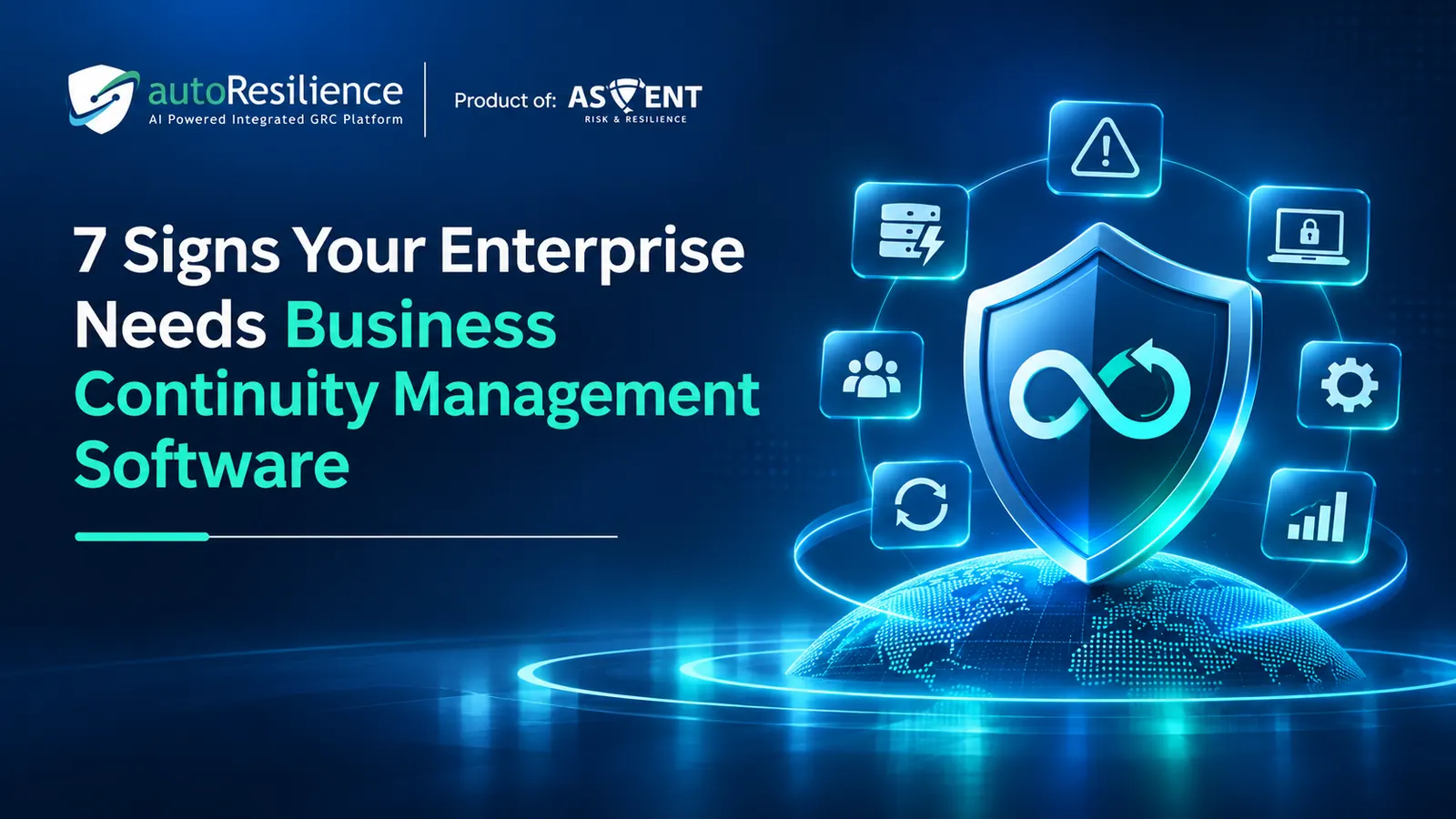
7 Signs Your Enterprise Needs Business Continuity Management Software

Shambhavi Singh
November 26, 2026
Having a business continuity plan is not the same as being ready for a disruption. For an enterprise with multiple locations, interconnected systems and external service providers, the real test is whether teams can recover critical operations within agreed timeframes — and demonstrate that capability before a crisis occurs.
Spreadsheets, shared drives and email approvals may be sufficient when a continuity programme is small. As the enterprise grows, however, these tools can make it difficult to maintain accurate information, coordinate recovery and demonstrate accountability. Purpose-built Business Continuity Management Software helps bring these activities into a governed, connected environment.
How do you know when your organisation has reached that point? Here are seven practical signs that it is time to move beyond manual BCM.
1. Your Business Continuity Plans Are Outdated or Difficult to Find
A department changes its operating model. An application moves to the cloud. A recovery team member leaves the organisation. Each change can make parts of a business continuity plan (BCP) obsolete, yet the document may remain marked as approved.
When plans are distributed across shared folders and individual devices, continuity managers spend considerable time tracking versions and chasing approvals. During a disruption, staff may act on inconsistent instructions or contact people who no longer hold the relevant responsibilities.
What to look for: overdue plan reviews, multiple copies of approved plans, missing owners and updates that cannot be traced to a decision.
How BCM software helps: a central plan repository, role-based access, version history, review reminders and approval workflows can establish a reliable source of continuity information. Enterprises should also arrange secure offline access to essential plans in case the primary system is unavailable. Read more about automating business continuity plans.
2. Business Impact Analysis Is Still a Manual Exercise
Business Impact Analysis (BIA) identifies critical activities, the consequences of disruption and the time within which those activities need to recover. When each department maintains a separate spreadsheet, inconsistent scoring methods and incomplete dependency information make enterprise-wide prioritisation difficult.
For example, a customer service function might require recovery within four hours, while a supporting identity system has an eight-hour recovery target. If those dependencies are not mapped, both targets may be approved without anyone recognising the conflict.
What to look for: inconsistent recovery time objectives (RTOs), missing recovery point objectives (RPOs) for relevant data, duplicated assessments and lengthy consolidation exercises.
How BCM software helps: standardised BIA questionnaires, dependency mapping, validation workflows and consolidated reporting can reveal gaps between business recovery requirements and available recovery capabilities. Explore how a BCM tool improves risk assessment, planning and response.
3. Your Recovery Exercises Do Not Demonstrate Readiness
An annual tabletop exercise may be useful, but attendance and completion alone do not prove that critical services can be restored. A credible exercise programme tests assumptions, evaluates recovery performance and ensures that identified weaknesses are addressed.
If exercise results are recorded in presentation decks or meeting minutes, corrective actions can disappear between review cycles. The same issues may emerge repeatedly, even though the organisation reports that testing is complete.
What to look for: exercises that lack measurable success criteria, untested critical dependencies, repeated findings and corrective actions without accountable owners.
How BCM software helps: structured exercise schedules, scenario records, recovery performance evidence and action tracking support a repeatable test-and-improve cycle. This also strengthens operational resilience by connecting continuity activities to the services the organisation needs to protect.
4. Crisis Response Depends on Calls, Emails and Individual Memory
When a major disruption occurs, leaders need to know which services are affected, who is responsible for recovery and which decisions require escalation. If the answer depends on locating a particular individual or piecing together several messaging threads, response coordination becomes fragile.
Consider a regional outage affecting multiple offices. Without a common view of the incident, different teams may issue conflicting updates, duplicate recovery tasks or overlook a critical handover.
What to look for: outdated contact lists, unclear activation authority, manual status collection and incomplete incident timelines.
How BCM software helps: plan activation workflows, named response roles, task tracking and decision logs can improve coordination. Integration with incident and crisis management software can help maintain a shared view of the event, while alternate communication channels remain essential if normal systems fail.
5. Critical Supplier and Technology Dependencies Are Not Visible
Enterprise continuity extends beyond internal teams. Payment processors, cloud providers, logistics partners and outsourced service providers can all affect whether a critical business service remains available.
A supplier may have an approved continuity plan and still be unable to meet your organisation’s recovery needs. Likewise, two supposedly independent services may rely on the same underlying infrastructure. Without a connected view of dependencies, these concentrations of risk can remain hidden.
What to look for: incomplete supplier recovery information, undocumented single points of failure, mismatched recovery commitments and no tested alternatives for critical third parties.
How BCM software helps: linking business processes to suppliers, applications and recovery strategies can make dependency risks visible. Connecting continuity planning with third-party risk management and IT and cyber risk management supports more informed recovery decisions.
6. Audit and Compliance Evidence Takes Too Long to Assemble
If every audit requires weeks of searching for approved plans, BIA records, testing evidence and corrective actions, the continuity programme may be working harder to demonstrate governance than to improve resilience.
ISO 22301 provides a framework for establishing, maintaining and improving a business continuity management system (BCMS). Software can support the associated documentation and evidence requirements, but it does not replace effective governance, implementation or independent assessment.
What to look for: missing approval records, inconsistent evidence, manual audit packs and limited traceability between findings and remediation.
How BCM software helps: structured records, review histories and corrective action evidence can improve audit readiness and reduce repetitive evidence collection. Learn more about BCM software and ISO 22301 audit readiness or explore the ISO 22301 compliance solution.
7. Leadership Cannot See Enterprise-Wide Continuity Readiness
Senior management needs more than a count of completed plans. It needs to understand which critical services are exposed, where recovery targets have not been demonstrated and which unresolved weaknesses require investment.
When every department reports readiness differently, a green status on a dashboard can hide significant gaps. Executives may approve budgets without understanding whether the proposed investments address the most material continuity risks.
What to look for: manually assembled management reports, inconsistent readiness measures and no consolidated view of overdue exercises or high-priority recovery gaps.
How BCM software helps: configurable dashboards, consistent readiness measures and risk-based action tracking can give management a clearer view of resilience performance. Useful indicators include the percentage of critical services with current BIAs, plans reviewed on schedule, recovery objectives achieved in tests and overdue corrective actions.
How to Evaluate Enterprise Business Continuity Management Software
If several of these signs are familiar, start with your actual operating model rather than a generic feature checklist. Ask shortlisted vendors to demonstrate an end-to-end scenario using a representative critical service: complete its BIA, map dependencies, approve a recovery plan, conduct an exercise, record a finding and produce management evidence.
Evaluate whether the platform supports configurable workflows, multi-entity governance, role-based permissions, audit trails, integration with existing risk and incident systems, reporting and secure access during disruption. Assess implementation effort, data migration, user adoption and the resilience of the software itself. For a more detailed evaluation, see 10 features enterprises should look for in BCM software.
Move From Document-Based BCM to a Connected Continuity Programme
The value of business continuity management software is not simply replacing spreadsheets. It is establishing a repeatable way to understand business impacts, maintain recovery strategies, coordinate response, test readiness and resolve gaps across the enterprise.
AutoResilience brings business continuity management into a broader governance, risk and compliance environment. Explore how a connected approach can support your continuity programme and help your teams turn recovery requirements into actionable, measurable activities.
Explore the AutoResilience BCM Platform → Take the BCM Maturity Assessment →
Written by

Shambhavi Singh is a Marketing Executive at Ascent Risk & Resilience, where she contributes to brand communication, content strategy, and digital storytelling across the organization’s risk and resilience solutions. With a background spanning content writing, voice-over artistry, anchoring, public speaking, and social impact, she brings both creativity and clarity to every message she crafts.
Shambhavi’s passion for communication started early in her hometown of Varanasi, where her curiosity for culture and heritage shaped her worldview. A natural storyteller and confident speaker, she has built a strong presence as a social media writer and continues to use her voice to inform, inspire, and engage audiences.
Driven by a blend of will and skill, she is committed to building meaningful connections, leading with empathy, and contributing to initiatives that create positive change. A social worker at heart and a marketer by profession, Shambhavi combines creativity, purpose, and leadership in everything she does.